
What Makes a Renovation Look Expensive Even When It Isn't the Most Expensive Option?
There is a big difference between a renovation that costs a lot of money and one that looks thoughtfully expensive.
We have seen beautiful materials fall flat because the proportions were wrong, the lighting was an afterthought, or too many finishes were competing for attention. We have also seen relatively simple materials look incredible because every detail around them was considered.
That is one of the things we think about constantly at DuBois Design+Build. Where is the money actually going to make a difference? What details will make the room feel intentional? And where can we choose a simpler option without sacrificing the finished look?
If you want your renovation to feel elevated, these are some of the details that matter far more than simply picking the most expensive option in the showroom.

1. Get the Proportions Right
One of the quickest ways to make a beautiful room feel off is incorrect proportion.
An island can be too large for the kitchen. A pendant can be too small over a substantial island. A vanity can feel undersized on a long bathroom wall. A tiny piece of art can disappear over a large fireplace.
None of those problems are solved by spending more money.
Before we get caught up in finishes, we look at the bones of the room. Cabinet heights, walkway widths, window placement, fixture sizes, furniture clearances and the relationship between architectural elements all matter.
A $400 light fixture that is properly scaled can look significantly better than a $2,000 fixture that is too small for the room.
Good proportion is one of those things you might not consciously notice when it is right. You just walk into the space and it feels finished.

2. Use Fewer Materials, More Intentionally
More finishes do not automatically create more interest.
In fact, one of the easiest ways to make a renovation feel high-end is to edit.
Instead of trying to fit several statement materials into one room, choose one or two places to create interest and allow the rest of the room to support them.
If you have a beautiful stone countertop with dramatic movement, maybe the backsplash does not also need to demand attention. If the cabinetry has a strong color, perhaps the flooring should be quieter. If the tile is the star of the bathroom, the plumbing fixtures can have simpler silhouettes.
Luxury often comes from knowing when to stop.
We talked more about using personality intentionally in Creative Design Choices That Completely Change the Vibe of a Space.

3. Pay Attention to Where Things Line Up
This is a small detail with a huge impact.
Look at a beautifully designed kitchen or bathroom and start paying attention to the lines.
Does the edge of the mirror align with the vanity? Are the sconces centered intentionally? Does the backsplash terminate in a logical place? Are the upper cabinets aligned with something below them? Does the tile layout create awkward slivers at the edges?
These details do not necessarily add thousands of dollars to a project, but they can completely change how polished the finished room feels.
During the design and construction process, we spend time thinking about those relationships because once you see an awkward alignment, it can be difficult to unsee it.
4. Take Something All the Way
Sometimes the more luxurious decision is not adding another material. It is taking one material farther.
Instead of stopping tile at an arbitrary height, take it to the ceiling.
Instead of using a small backsplash behind a bathroom vanity, consider treating the entire wall.
Instead of ending cabinetry at eight feet when you have taller ceilings, evaluate whether extending it upward would improve the architecture of the room.
Instead of a small accent of stone around a fireplace, let the material become a larger architectural feature.
This does not mean every material needs to cover every surface. The point is to make the stopping points feel intentional.
When a material ends because the design says it should, rather than because "that's just where backsplash usually stops," the room tends to feel much more custom.
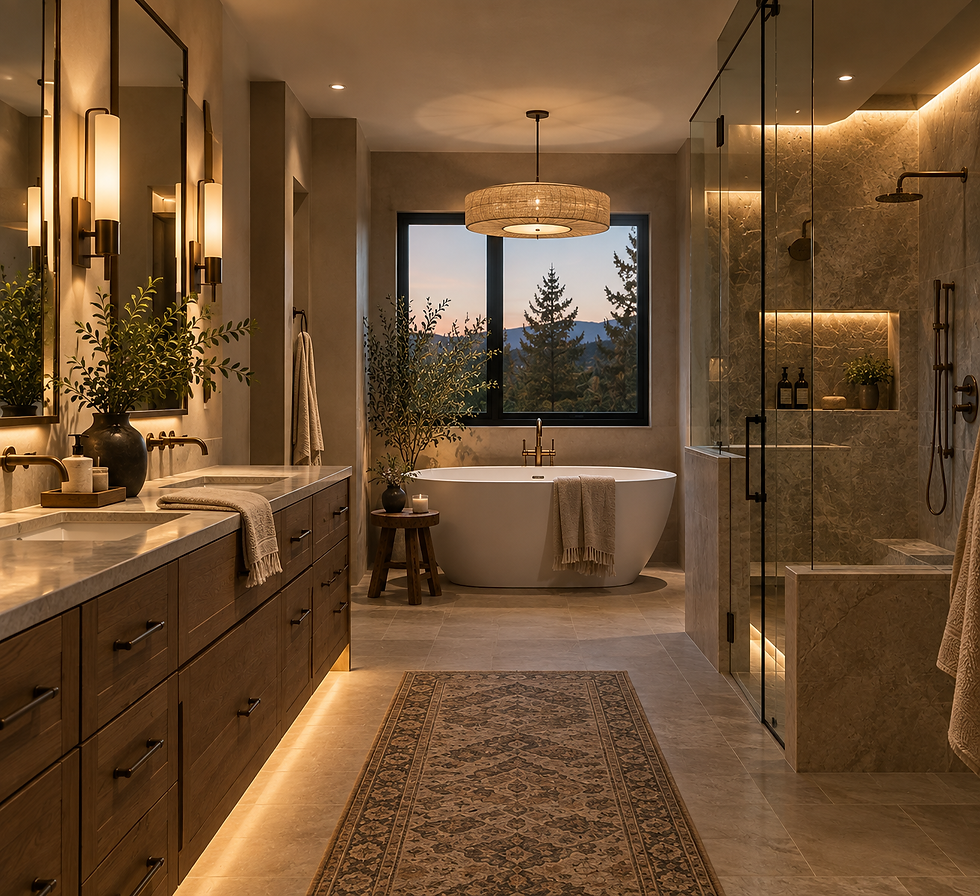
5. Spend Money on Lighting Placement, Not Just Light Fixtures
You can buy a gorgeous chandelier and still have a poorly lit room. Good lighting is layered.
A kitchen might need recessed lighting for general illumination, pendants for the island, under-cabinet lighting for tasks and decorative lighting for warmth. A bathroom may benefit from lighting at the mirror in addition to overhead fixtures. Built-ins can completely change when subtle integrated lighting is added.
The fixture itself matters, but where the light comes from and what it illuminates matters just as much.
Lighting also affects every other finish you selected. Beautiful cabinetry, tile and countertops can look completely different under harsh or poorly placed lighting.
This is why we prefer to think about lighting during the design phase rather than treating it as something to select at the end.

6. Make the Everyday Stuff Disappear
Nothing ruins a beautiful countertop faster than realizing there is nowhere to put anything.
The coffee maker, toaster, hair dryer, charging cords, trash cans, cleaning supplies and stacks of towels all have to live somewhere.
One of the things that makes a custom renovation feel luxurious is that the everyday clutter has been considered.
That might mean an appliance garage in the kitchen, an outlet inside a vanity drawer, a dedicated linen cabinet, hidden trash and recycling, a charging drawer, or cabinetry specifically designed around the things you actually own.
The result is not necessarily flashy. It is simply easier to live in.
And when the everyday items have a home, the beautiful parts of the renovation get to stay beautiful.

7. Let One Thing Be Special
Not everything needs to be the upgrade.
This is one of our favorite ways to approach a budget.
Maybe you choose a relatively simple cabinet door but invest in a beautiful stone countertop. Maybe the majority of the bathroom uses an approachable field tile, but one wall gets something incredible. Maybe the flooring is understated so you can spend more on the windows that completely change the room.
A renovation becomes much more interesting when there is a clear hierarchy.
Ask yourself: What do we want someone to notice first when they walk into this room?
Then give that element permission to be special.
This is also why we don't believe every "luxury upgrade" belongs in every home. We shared more about deciding which improvements are actually worth prioritizing in The Luxury Home Upgrades Homeowners Never Regret.

8. Don't Underestimate Trim, Transitions and the Less Exciting Details
Nobody starts a renovation Pinterest board with pictures of drywall returns.
But these are exactly the kinds of details that separate a finished-looking renovation from one that feels pieced together.
How does one flooring material transition into another? Where does tile stop? How does new trim meet existing trim? What happens where cabinetry meets a wall that isn't perfectly straight? Are vents and outlets located thoughtfully, or do they interrupt an otherwise beautiful feature?
These details aren't glamorous during the design process, but they become very visible once construction is complete.
The best renovations solve them before they become problems.
9. Don't Add Square Footage Until You've Made the Existing Space Work
Sometimes the most expensive solution is not the best solution.
Before assuming a home needs an addition, we look for opportunities within the existing footprint. Could a hallway be reduced? Could an awkward closet be relocated? Is there unused space between rooms? Could moving a doorway completely change how the room functions?
A better floor plan can make the same square footage feel dramatically more luxurious.
We explored this idea more in What We'd Change in Your Home Before Adding Square Footage.
This is also one of the reasons design and construction need to work together. A great idea on paper still has to make sense structurally, practically and financially.

10. Choose Materials for How They Work Together, Not Their Price Tags
A material does not need to be expensive to look beautiful.
The important question is what happens when you put everything together.
A relatively affordable tile can look incredibly elevated with the right grout color, layout and surrounding finishes. Simple cabinetry can feel custom with thoughtful proportions and hardware. An understated countertop can be exactly what a room needs if something else is providing the visual interest.
This is where designing the room as a whole becomes so important.
If you select every finish independently because you love each one individually, you can end up with a room full of beautiful things that don't quite belong together.
We would rather have the finishes tell one cohesive story.
That philosophy is also behind many of the ideas in 10 Things That Make a Home Feel Custom Without Adding Square Footage.
The Most Expensive Option Isn't Always the Most Luxurious One
A successful renovation isn't about finding the highest-priced tile, appliance, faucet or light fixture.
It is about knowing where those investments matter.
Good proportions. Intentional material choices. Thoughtful lighting. Clean transitions. Functional storage. Strong craftsmanship. A floor plan that actually works.
Those decisions may not be the first things someone points out when they walk into your home, but together they create the feeling that everything belongs exactly where it is.
That is what makes a renovation feel truly custom.
At DuBois Design+Build, we approach renovations from both sides of the equation: how the home should look and how it actually needs to be built. From initial design and material selections through construction, our goal is to help homeowners make thoughtful decisions about where to invest, where to simplify and how to create a home that feels personal, functional and beautifully finished.
Planning a renovation? Visit DuBois Design+Build, call (720) 347-7400, or email Dubois@duboisdesignbuild.com to start the conversation.


