
Creative Design Choices That Completely Change the Vibe of a Space
Some rooms are beautiful, but you forget about them five minutes after you leave. Others stick with you. Usually, the difference is not that one room had a bigger budget or more expensive finishes. It is that someone made an interesting choice. Maybe they wrapped the ceiling in wood, used an antique cabinet as a bathroom vanity, carried dramatic tile somewhere unexpected, or chose a light fixture that feels more like art than lighting.
Those choices give a home personality.
At DuBois Design+Build, we love a timeless home, but timeless does not have to mean safe. In fact, some of the best renovations balance classic materials and thoughtful layouts with a few decisions that are unexpected, personal, and even unique.
If you want your home to feel less like a showroom and more like your home, these are some of our favorite ways to get there.
1. Put a Material Somewhere It Is Not Expected

One of the easiest ways to create a memorable space is to take a familiar material and use it somewhere unexpected.
Think natural stone behind open shelving instead of a traditional backsplash. Wood shingles or shakes can create texture on an interior feature wall. Handmade tile can continue beyond the expected backsplash area and wrap an entire wall. Plaster can transform a standard range hood into an architectural feature.
The material itself does not necessarily have to be unusual. The placement is what makes it interesting.
This works especially well when the material has texture. Stone, wood, handmade tile, brick, plaster, and other natural finishes create depth that a flat painted wall simply cannot.
The key is restraint. If every surface is competing for attention, none of them feel special. Give one material room to be the moment.
For more ideas on using natural materials in a way that will age beautifully, read our Luxury Home Design Trends That Will Still Look Beautiful 15 Years From Now.
2. Do Something With the Ceiling

The ceiling is one of the largest surfaces in a room, and somehow it is also one of the most ignored.
There are so many opportunities beyond white drywall. Wood planking can make a large room feel warmer. Beams can give an open space architectural structure. Wallpaper can make a powder bathroom or bedroom feel completely different. Even painting the ceiling a deeper version of the wall color can make a room feel more intentional.
This is especially powerful in rooms that otherwise have simple finishes. You do not necessarily need dramatic cabinetry, bold countertops, statement tile, and an elaborate ceiling. Sometimes a relatively quiet room with one incredible ceiling has much more impact.
A ceiling treatment can also help define spaces within an open floor plan without physically dividing them. A wood ceiling over the kitchen, for example, can visually separate it from the adjoining living space while still allowing everything to flow together.
3. Use Something Old in a Brand-New Space
Not everything in a renovation needs to be new. In fact, incorporating something with age can be exactly what keeps a newly renovated room from feeling too perfect.
An antique dresser can become a bathroom vanity. Vintage doors can lead into a pantry. Reclaimed beams can bring warmth into a clean, modern kitchen. Old brass hardware, architectural salvage, vintage lighting, or an antique cabinet can introduce character that is difficult to recreate with brand-new materials.
The contrast is what makes this work.
A beautifully restored antique against fresh plaster walls or new stone feels intentional because the two elements make each other more interesting. The old piece brings history. The new surroundings allow it to stand out.
You also end up with something that is much harder to duplicate, which is one of our favorite parts of custom design.
4. Give the Smallest Room the Biggest Personality

You do not have to make your kitchen or living room the boldest space in the house. Sometimes the best place to take a design risk is somewhere small.
Powder bathrooms, pantries, laundry rooms, mudrooms, home bars, little offices, and even hallways are great opportunities to do something you might hesitate to commit to across an entire main level.
Use the wallpaper. Choose the deep green cabinetry. Wrap the room in color. Install the unusual tile. Paint the ceiling. Add the light fixture you cannot stop thinking about.
Because these spaces are smaller, you can often use a stronger design idea without overwhelming the rest of the home. They also create an element of surprise. A relatively calm main level followed by an incredible little powder room is much more fun than having every room look exactly the same.
5. Try Color Drenching Instead of an Accent Wall
If you love a color, consider committing to it.
Instead of putting a deep color on one wall and leaving everything else white, color drenching carries that color across the walls, trim, doors, built-ins, and sometimes the ceiling.
The result can actually feel more sophisticated than a traditional accent wall because the room becomes one complete environment.
Deep greens can make an office or library feel intimate. Rich brown can create an incredible moody bedroom. Muted blue can completely change a bathroom. Even warm creams and taupes can be drenched throughout a room for a softer, quieter effect.
The important part is choosing a color you genuinely love and considering how natural and artificial light will affect it throughout the day.
We went deeper into this idea in Color Drenching: Should You Do It?, including where it works best and how to keep it from feeling overwhelming.
6. Mix Materials That Should Not Necessarily Go Together
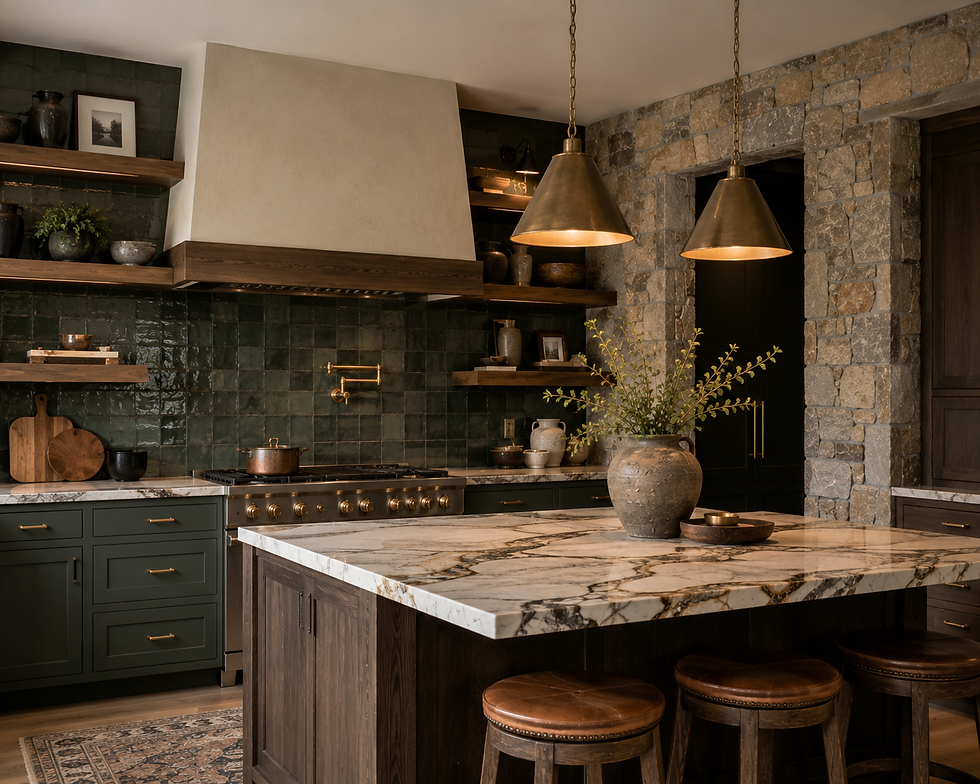
Some of our favorite spaces have a little tension in them.
A room filled entirely with polished materials can feel cold. A room filled entirely with rustic materials can feel heavy. Combining the two is often where things get interesting.
Try rustic wood against polished stone. A sleek quartzite countertop with handmade tile. A plaster wall with aged brass. Natural oak beside deep painted cabinetry. A refined marble bathroom with an antique wood vanity.
You can even mix different eras. A very contemporary light fixture can look incredible in a traditional room when the rest of the design gives it enough breathing room.
The goal is not to make everything match. It is to make everything feel like it belongs together.
That distinction is important. Great design often has contrast, but there is still a thread connecting the materials through color, proportion, texture, or repetition.
7. Choose One Thing That Is a Little Weird
This might be our favorite one.
Every memorable home deserves something that makes you look twice. Maybe it is an oversized pendant above the dining table. An unexpected stone with dramatic veining. A curved doorway. Unusual cabinet hardware. A tile pattern you have never seen before. A built-in reading nook tucked into an otherwise unused corner.
It does not need to appeal to everyone.
Actually, that is kind of the point.
When every design decision is made based on what will have the broadest possible appeal, homes can start to feel interchangeable. If you are renovating a home for yourself, there should be at least a few choices that exist simply because you love them.
One unexpected feature surrounded by more restrained choices can give an entire room its identity.
8. Turn Functional Necessities Into Design Features
Some of the best opportunities in a renovation start with things the house needs anyway.
You need a range hood. Why not make it architectural?
You need a stair railing. Why not treat it like a custom design element?
You need storage. Instead of filling a room with freestanding furniture, could the storage become a beautiful built-in?
The same thinking can apply to doors, shelving, vent covers, fireplaces, niches, benches, cabinetry, and even transitions between rooms.
Rather than trying to hide every functional element, ask whether one of them could become part of the architecture.
This is one of the differences between simply replacing finishes and actually redesigning a space. When we approach a renovation through both design and construction, we can look for these opportunities early enough to actually build them into the home.
If you want more examples of the architectural details that make a home feel intentional, read 10 Things That Make a Home Feel Custom (Without Adding Square Footage).
9. Let Natural Materials Be Imperfect
Perfect is not always more luxurious. Natural stone has variation. Wood has knots. Handmade tile is not perfectly uniform. A hand-applied plaster finish has movement. Unlacquered brass changes with time.
Those variations are often exactly what make the material beautiful.
Trying to eliminate every irregularity can remove some of the character that made you choose the material in the first place.
This is especially important when you are trying to create a home that feels warm, collected, or established rather than brand-new and untouched. Materials that develop character over time can help a renovation settle naturally into the home.
The goal is quality, not perfection.
10. Create a Moment Where Nobody Expects One

Not every design feature needs to be in the obvious place.
Some of the most fun moments can happen at the end of a hallway, behind a pair of doors, inside a pantry, underneath a staircase, at a stair landing, or on the back wall of a built-in.
These smaller moments reward you for actually living in the home.
Maybe the inside of the pantry is painted a completely different color. Maybe a hallway ends with a piece of art illuminated by a picture light. Maybe an unused nook becomes a tiny built-in library. Maybe the back of an open cabinet is covered in stone or tile.
When we design a renovation, we look at these in-between spaces because they are often overlooked. They may not add square footage, but they can add a tremendous amount of character.
11. Stop Trying to Name Your Design Style

This can be surprisingly freeing.
Homeowners often feel like they need to decide whether their home is transitional, modern, traditional, organic modern, mountain contemporary, modern farmhouse, or one of the dozens of other labels floating around online.
Those categories can be helpful, but they can also become restrictive. Instead, think about how you want your home to feel.
Warm. Moody. Quiet. Collected. Playful. Old-world. Airy. Dramatic. Cozy. Refined. Those words can sometimes lead to better design decisions than choosing a style label.
If the goal is "warm and collected," we might bring in aged finishes, natural wood, layered lighting, vintage elements, and materials with visible texture. If the goal is "quiet and refined," the choices may become more restrained, with beautiful proportions and subtle material changes doing most of the work.
You can still create a cohesive home without forcing every decision into one design category.
12. Know When to Stop
Creative design does not mean putting an idea on every surface. In fact, restraint is usually what allows the most interesting choices to work.
If the countertop has dramatic movement, the backsplash might need to quiet down. If you are using bold wallpaper, the vanity may need to be simpler. If an antique piece is the focal point, it should not have to compete with five other focal points.
We often think of a room as having a hierarchy. Something gets to speak the loudest, a few elements support it, and the rest create the backdrop.
That balance is what keeps a unique home from becoming chaotic.
It is also why design decisions are easier when they are made together instead of one at a time. Our Luxury Home Upgrades Homeowners Never Regret article explores this same idea from another angle, focusing on the decisions that continue adding value to daily life long after a renovation is finished.

The Best Homes Have a Point of View
A beautifully designed home should not feel like a collection of whatever was popular when it was renovated. It should feel like somebody lives there.
That might mean taking a risk with color, putting stone somewhere unexpected, bringing an antique into a new bathroom, covering a ceiling in wood, or choosing one feature that your friends would never have picked for their own homes.
Good design gives those ideas structure. It considers how the unusual choice relates to the architecture, how it will function, how it will be built, and what needs to stay quiet around it.
At DuBois Design+Build, that is a big part of why we approach renovations through both design and construction. We can explore the creative possibilities while also thinking through how they will actually come together in the finished home.
If you are planning a renovation, addition, or custom home and want something that feels thoughtful, personal, and distinctly yours, we would love to hear what you are imagining.
Visit DuBois Design+Build at https://www.duboisdesignbuild.com/, call (720) 347-7400, or email Dubois@duboisdesignbuild.com to start the conversation.


